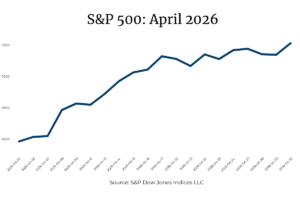
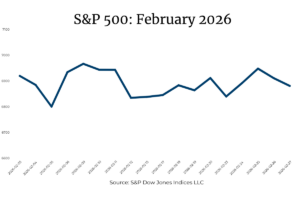
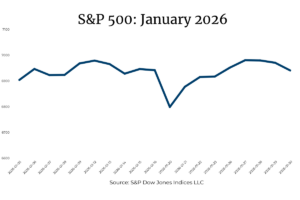
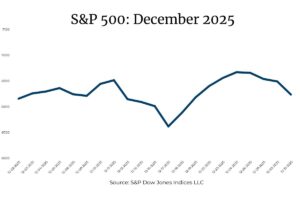
The U.S. economy displays continued resilience as we hit the mid-year point of 2026 despite considerable headwinds. The biggest risks we’ve seen so far include:
- Inflation that remains above the Federal Reserve’s target.
- Cautious consumer spending.
- Higher interest rates.
On the other hand, we’ve seen strong business investment, particularly in artificial intelligence (AI) and technology infrastructure. That means corporate earnings remain strong in the tech sector and beyond. Here’s what we’re watching in the second half of the year.
The U.S. economy in the second half of 2026
Despite concerns about inflation and geopolitics, the U.S. economy is growing about 2.2-2.5% per year. That is to say, it’s growing slightly more than its long-term average of 2.1% per year.
While consumers seem cautious, the data shows they remain relatively healthy, financially speaking. The unemployment rate is 4.2%, wage growth continues, and Bank of America reported consumer spending was up 6.0% year-over-year in June (5.6% excluding gasoline purchases). Household debt remains manageable relative to income, while household net worth is near record highs, providing an important cushion for future spending.
Corporate America looks strong
Ultimately, stock prices tend to follow corporate earnings over time—and earnings remain one of the strongest supports for today’s market.
According to the report:
- First-quarter S&P 500 earnings grew nearly 30%.
- Second-quarter earnings are expected to increase approximately 23%, with some estimates approaching 29%.
- Full-year 2026 earnings growth is projected between 23% and 24%.
Technology companies continue to lead this growth, but earnings are also expanding across industrials, materials, energy, and increasingly among mid-sized and smaller companies, creating a healthier and broader market environment.
Artificial Intelligence isn’t just a tech-sector play
Artificial intelligence seems to be transitioning from trend to long-term investment theme.
Companies are expected to invest approximately $1 trillion annually during both 2026 and 2027 building AI infrastructure, including data centers, semiconductor manufacturing, software, and related technologies. These investments are benefiting not only technology companies, but also businesses that manufacture equipment, build infrastructure, transport materials, and supply energy.
This broader investment cycle helps explain why sectors such as Industrials, Materials, and Energy have become increasingly important contributors to market performance.
Watch for market diversification
For much of the past several years, a small group of large technology companies drove market returns. That picture seems to be changing.
Leadership expanded I the first half of the year to include financials, healthcare, industrials, energy, and smaller companies. In the first six months of 2026, the Russell 2000 Index of small-cap stocks gained nearly 22%, significantly outperforming the broader market. At the same time, the equal-weighted S&P 500 reached new highs, indicating that gains are being shared across a much wider range of companies.
Broader participation is generally viewed as a positive sign because market advances become less dependent on just a handful of companies.
Several sectors appear well positioned to benefit from long-term economic trends:
- Technology continues to benefit from AI-driven investment and strong earnings growth.
- Industrials and Materials are seeing increased demand from infrastructure projects tied to AI and manufacturing expansion.
- Energy companies may benefit from continued global energy demand and expanding electricity needs from data centers.
- Banks are benefiting from a more favorable interest-rate environment and improving capital markets activity.
- International markets, particularly developed markets and emerging markets outside China, are showing improving earnings trends and may offer additional diversification opportunities.
What to expect from the bond market
The report expects long-term Treasury yields to remain within their recent trading ranges, while the Federal Reserve could have flexibility to lower short-term rates later this year if inflation continues to improve. Stable interest rates would provide a more supportive backdrop for both stocks and bonds.
Risks Worth Watching
While the outlook remains positive, investors should continue monitoring several important risks:
- Inflation could remain higher than expected, delaying potential interest-rate cuts.
- Elevated government debt and interest costs could place upward pressure on long-term interest rates.
- Geopolitical conflicts may continue to create periods of market volatility.
- Corporate earnings expectations have risen significantly, making future earnings reports especially important.
Bottom Line
Although market volatility is likely to continue, the underlying fundamentals remain encouraging. Economic growth has held up better than many expected, corporate earnings continue to expand, consumers remain financially healthy, and investment is spreading across a broader range of industries.
Rather than attempting to predict every short-term market move, history continues to favor investors who maintain diversified portfolios, stay focused on long-term objectives, and remain disciplined through periods of uncertainty. As market leadership broadens and new opportunities emerge across sectors and regions, diversification remains one of the most valuable tools available to long-term investors.