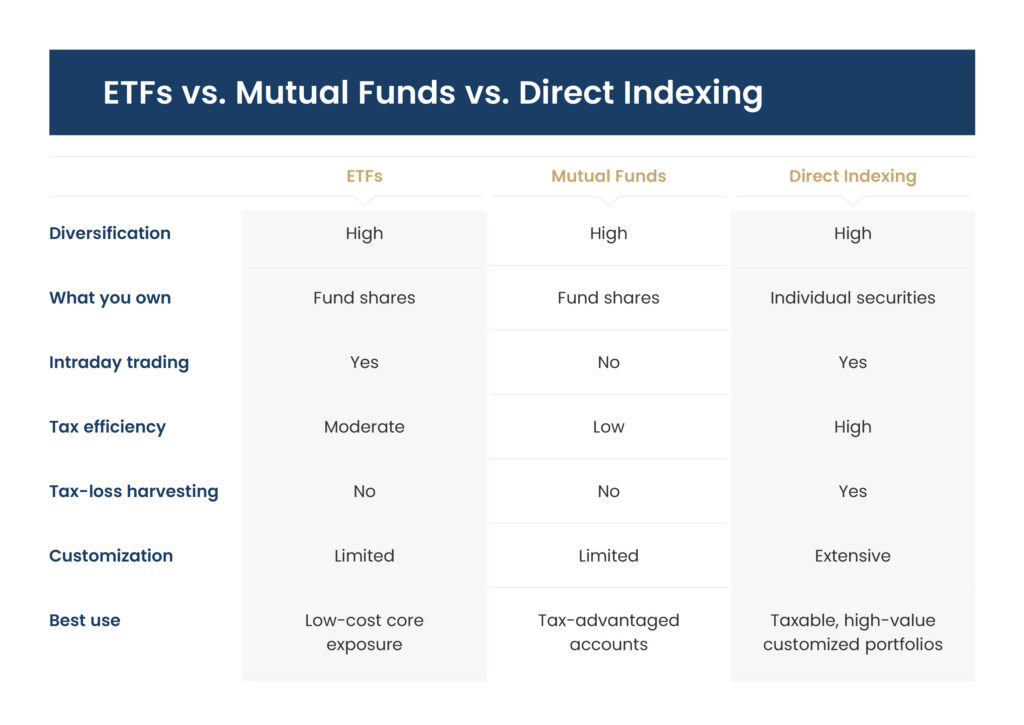
We frequently talk about the importance of a diversified portfolio. Diversification across a wide array of stocks can help protect investors from certain types of market risk. There are several ways to invest in a diversified bucket of stocks; the most common include mutual funds, exchange-traded funds (ETFs), and direct indexing.
What are mutual funds?
Mutual funds pool investors’ money and then use the funds to invest in a group of assets. These funds tend to be actively managed according to a specific prospectus. Some might mirror a specific index, like the S&P 500, but they might also follow a more niche investment strategy.
These days, mutual funds tend to be most commonly found in 401(k)s and employer-sponsored plans. While mutual funds have numerous perks, they also include several drawbacks. Mutual funds:
- Are not particularly tax efficient.
- May have higher fees (such as management and load fees) than ETFs.
- Usually only trade once per day.
- May have minimum investments and/or rules around withdrawals.
What are exchange-traded funds (ETFs)?
ETFs have slowly begun replacing mutual funds in terms of the preferred way to invest in an array of stocks. An ETF is a pooled investment vehicle that owns a collection of securities. When you buy an ETF that tracks the S&P 500 index, you would own a share of the ETF, not the individual companies. This creates certain tax advantages compared to a mutual fund.
ETFs trade on public exchanges, similar to a stock, meaning they’re highly liquid. While ETFs used to be associated with passive index funds and low fees, there are now innumerable types of ETFs to choose from, many of which are actively-managed, and some of which have high fees.
What is direct indexing?
Direct indexing changes the structure entirely.
Instead of buying a fund that owns the securities in an index, the investor owns the underlying stocks directly. A direct-indexing portfolio might seek to approximate the S&P 500, for example, by buying the stocks that comprise the index (or using similar stocks).
While ETFs are tax efficient in that they don’t generate the types of capital gains that may occur in a mutual fund, they typically can’t help an investor get strategic about their taxes. That’s where direct indexing can help; it allows you to tax-loss harvest.
Beyond that, direct indexing allows you to customize which stocks make up your index. In fact, at Quorum Private Wealth, we call this approach custom indexing. This can help if you have concentrated stock positions, are prohibited from investing in a specific stock (such as the company you work for), or have a particular investing philosophy (such as not wanting to own ___ type of company).
This customization can add a level of complexity to direct indexing, so it’s important to work with a trusted advisor. There may also be different costs associated with this approach—transaction fees versus fund management fees, and so on.
Which approach should you use?
Some investors use all three approaches to diversified investing. For instance, they might use mutual funds in a workplace retirement account, use ETFs as a way to invest in bond markets, and use custom indexing for the stock allocation in their taxable account.
The best strategy for you likely depends on your personal circumstances—from your account balances to whether you’re investing via a taxable or tax-advantaged account.
A good financial advisor will look at your portfolio holistically to ensure proper diversification regardless of the investment vehicle(s). While ETFs and mutual funds can be a great way to get diversified exposure, direct indexing goes further by offering customization and tax optimization opportunities.
If you have questions about direct indexing and how we build custom indexes at Quorum, reach out to our team.
ETFs vs. Mutual Funds vs. Direct Indexing